

 Episode #393
Stop Blaming HR and Start Using It
Leaders love blaming HR for bureaucracy, red tape, and generally slowing things down.
But these same leaders have no idea how to use HR properly.
If you get this wrong in the age of AI, you’ll risk destroying one of the most valuable sources of insight in your company.
As we sit here in early 2026, AI is about to wipe out around half of what HR does. The leaders who figure how to manage the transition, and continue to benefit from the expertise and value that HR offers, will have a massive advantage.
LISTEN ON


Generate Your Free
Personalized Leadership Development Podcast Playlist
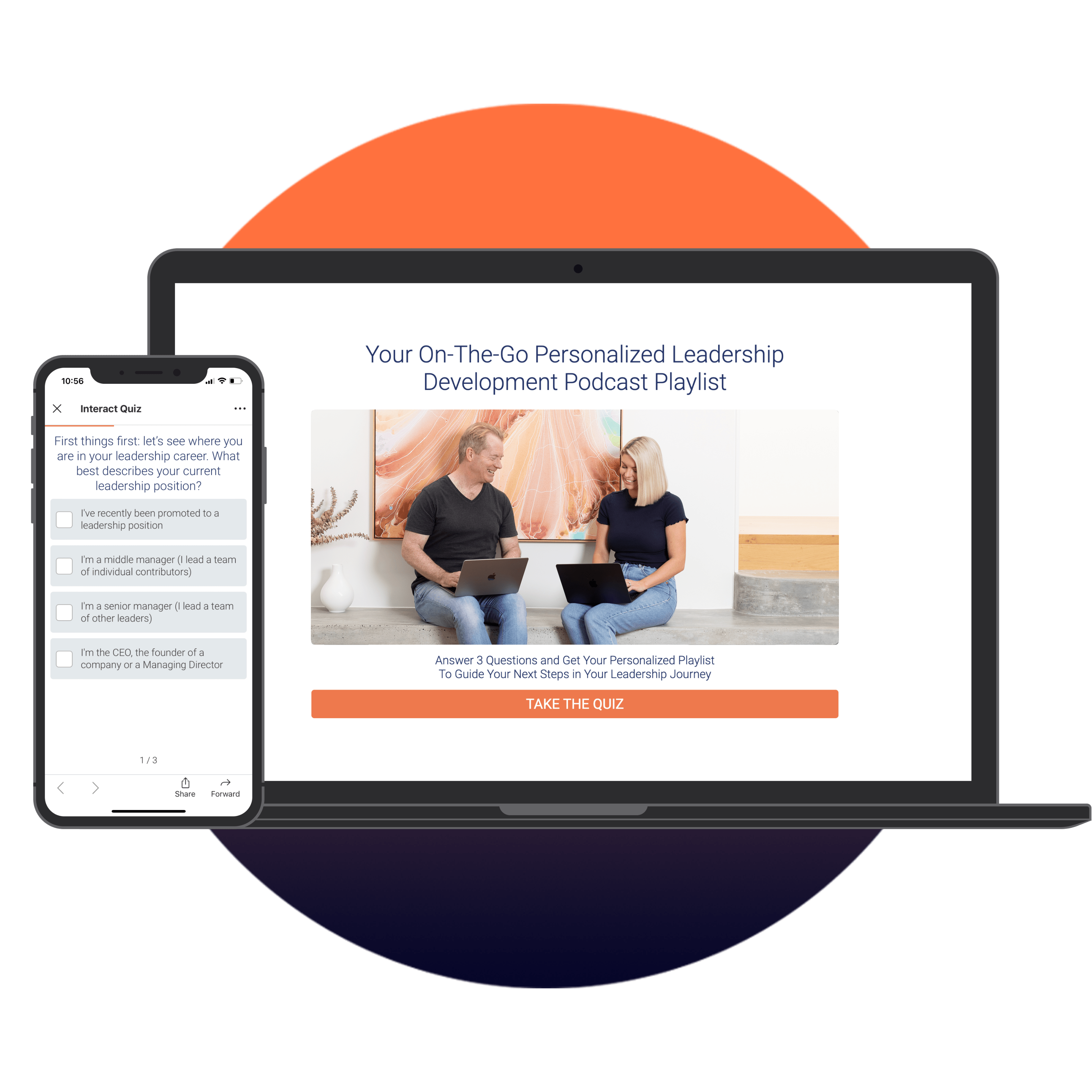
As a leader, it’s essential to constantly develop and improve your leadership skills to stay ahead of the game.
That’s why I’ve created a 3-question quiz that’ll give you a free personalized podcast playlist tailored to where you are right now in your leadership career!
Take the 30-second quiz now to get your on-the-go playlist 👇
Transcript
Episode #393
Stop Blaming HR and Start Using ItHR DOESN’T GET MUCH LOVE
Leaders love blaming HR for bureaucracy, red tape, and generally slowing things down. But these same leaders have no idea how to use HR properly.
If you get this wrong in the age of AI, you’ll risk destroying one of the most valuable sources of insight in the whole company.
HR is the easiest function in the company to blame but, most of the time, the real problem isn’t actually HR. They’re just executing the orders they get from above.
In the last five years in particular, the direction that HR has been asked to take has resulted in some particularly illogical and unhelpful policies, which leaders have been forced to follow.
In many cases, this has materially damaged company performance.
At the same time, it’s done little to enhance HR’s reputation.
As we sit here in early 2026, AI is poised to wipe out around half of what HR does. The leaders who figure out how to do this surgically, while still benefiting from the core value proposition of HR, are going to have a massive advantage.
I begin by briefly examining what the point of HR is; I look at a recent article from The Economist about the state of HR; and I finish with four ways to optimise your relationship with HR.
THE THREE STAGES OF HR EVOLUTION
HR professionals don’t get much love; but a good HR advisor is worth his weight in rocking horse droppings. They see the business from a vantage point that many people simply don’t have, because they usually have broad visibility across the whole organisation.
Just as the CFO has visibility of the whole financial picture, the head of HR has visibility over the whole people landscape. This has become increasingly important in recent years.
Different companies place different levels of importance on HR and, sometimes, that’s simply a function of size. In a small company, for example, you don’t really need an HR function—just the odd piece of expert advice to keep you out of jail if one of your employees lodges a claim against the company.
But larger companies can potentially benefit from a range of expert advice in the HR space. Like any other functional support team, the purpose of HR is to bring specialist domain expertise, and the tools and processes the business needs to optimise its performance.
In my experience, whether by design or by default, companies tend to deploy three potential HR models, each with ascending levels of potential business value.
The first stage HR model is highly transactional. It’s about the mechanics of HR: payroll, procedures, inductions, recruitment, headcount reporting, and so on: it’s the low-value commodity services, and pretty much all of it could be outsourced.
The only reason for you not to outsource it would be the potential benefits you could drive from internal economies of scale.
The second stage of the HR model is all the stuff in stage one plus business advisory.
You’ve probably heard the term HR business partners. HR business partners work with line management to advise them on people issues.
This moves their coverage into a more sophisticated space: industrial relations advice, leadership, performance management systems, key person risk, capability building, incentive schemes.
The third stage of the HR model is everything in stage two plus workforce planning, talent management, succession, leadership, and culture.
This is where the most value can be leveraged. HR assists the organisation to plan its future workforce based on its strategy, the predicted economic trends, and the future competitive landscape.
This necessarily has strong links to corporate strategy, and it attacks the big ticket items like attracting, retaining, and nurturing talent.
But even in the most rudimentary HR model, there’s a whole world of value to be found: there’s value simply in knowing that everyone is being paid according to your legal and contractual obligations. Not only does it put your mind at ease, but it reduces a key source of reputational risk.
WHAT DOES GOOD HR LOOK LIKE?
I’m a true believer in the value of, and the need for, HR. But HR can only be as effective as the CEO and the executive will allow it to be.
It also requires a strong HR leader to drive value into the company. But HR, as is the case with any corporate support function (like IT, risk or legal) can suffer from the syndrome of, “I’m from corporate, and I’m here to help.“
These eight words strike fear and terror into the heart of any line leader. Like any other functional team, this can only be changed when HR works out what truly creates value for the business, and then delivers it.
A lot of angst also arises in some companies because of unclear demarcation between HR and the internal customers it serves. HR’s been known to suffer from passive-aggressive abuse and even gaslighting from their internal customers because they don’t know how to push back.
For example, many line leaders are really happy to create a problem with poor leadership, and then when it all turns to sh!t, they handball it to HR, saying, “That’s a people problem, so HR needs to fix it.”
This demonstrates an incredibly poor understanding of where the accountability should lie between line management and HR.
When HR is at its best, it’s a strategic advisor to the CEO and the executive team.
It’s the philosophical custodian of culture, talent, and leadership.
A good HR group is highly pragmatic. It brings insights from the farthest corners of the business, which senior leaders rarely see. If the CEO could extract these insights and use them to plan for the company’s future talent and capability, the value of HR would be obvious.
If not, I’d go back and do a quick check of which HR model your company has chosen.
Is the mechanical side of HR only? Is it the business advisory model? Or is it a true strategic partner in capability and performance?
Just pause for a moment and reflect. How does HR function in your organisation? Is it level one, two, or three?
Whether you’re an HR practitioner or a leader trying to work out what HR is good for, you should ask yourself a few questions:
- Does my HR group have strong enough boundaries (and clear enough accountabilities) with the people it’s designed to serve?
- Is HR supported and valued at the highest levels of the business?
- Is the head of HR serious about improving the organisation’s leadership and culture, or happier just playing politics?
- Who in the business are the true believers? and
- How can I measure the value that HR delivers?
More than any other functional support area, I leant on HR heavily during my executive career. My biggest problem was getting HR advisors to overcome their conservative nature.
Like any other functional support area, I had to school HR on where the accountabilities actually lay.
Their job was to give me expert advice, including scenarios, risk assessment, and recommendations. They weren’t there to tell me what I could or couldn’t do.
I had to take their advice and weigh it in with everything else I was considering: legal, commercial, customer, reputation, et cetera. And I put it into the broader context and used it to shape my decision.
When this was done well, it was incredibly valuable, and I couldn’t have been successful without it.
HOW HR TOOK OVER THE WORLD
I came across an article in The Economist a little while ago, which was titled How HR Took Over the World. It was quite a brief article, but it made some very hard hitting points.
The key points are easy to summarise. In short, HR has been on an absolute tear for the last few years.
In 2024, American businesses employed 1.3 million HR professionals, which was up by 64% from 2014.
This massive growth compared to only 14% growth in overall employment over that same 10-year period. This trend has also been observed in countries like Australia and the UK.
What has driven this rise?
The first thing is the growing value of top talent, which has been offset by the declining availability of said talent.
Then there are the emerging social trends that forced more work into the HR team, all for good reason:
- When the #metoo movement broke, it brought a sharper focus to office harassment and misuse of positional power;
- COVID gave HR a major role (and, I suspect, more than the odd headache) in working out how to implement work from home and hybrid work models;
- Then there was DEI, which called for many flavours of HR response across a range of areas: everything from unconscious bias training, to writing new recruitment policies, to recommending how many unisex toilets the company should have on each floor.
Since the 1980s, when cases of companies taking advantage of workers were almost completely eradicated, industrial relations (IR) has become ever more complex, and now it would appear that employees are much better informed about their rights.
In American workplaces, the average number of allegations of discrimination or harassment jumped from 0.6% of employees in 2021 to 1.5% last year. That’s a 150% increase in complaints in just three years!
I know that, at least anecdotally, the US experience would only be the tip of the iceberg compared to countries like Australia and New Zealand, where the IR laws have become incredibly bureaucratic and highly restrictive.
But the article goes on to say that this surging trend in HR may be coming to an end.
Looking forward, the horizon doesn’t look quite as rosy.
As firms begin to lay off staff, you’d think that it would continue the HR boom, but it appears that HR professionals themselves are a key part of the cuts.
All non-revenue generating functions are going to come under increasing scrutiny and, in the US at least, the backlash to DEI has seen major programs dismantled, and the HR people who were delivering them sent to the job queue.
The compliance side of HR is already being quietly eroded by AI.
Let’s face it, I can get a pretty good summary of the relevant statutory and common law relating to workplace relations claims from ChatGPT. And, if I’m reasonably well-schooled in these principles, I can make pretty decent decisions without the need for an HR expert on my shoulder.
The same goes for hiring. As potential job candidates are getting smarter at using AI, they’re generating a thousand job applications and cover letters while they sleep. Companies are going to have to do the same, as they work out how to use AI to trawl through this every-increasing volume of applications.
Add to these woes a McKinsey study that found 22% of executives surveyed said AI had already led to a decrease in HR professionals.
This could well be the canary in the coal mine. AI is going to hit HR hard because many companies simply undervalue the function.
FOUR WAYS TO BETTER UTILISE HR
We know AI is coming, and we know that HR is going to be in the crosshairs, for a whole range of reasons.
As a huge believer in the people side of business, though, I’ve been thinking about what the path to victory is for extracting value from HR, as the nature of the function evolves.
Previous frustrations with HR policies, and their sometimes unwelcome impact on the business might convince you to cut the function more aggressively than is actually necessary.
It’d be so easy to throw the baby out with the bathwater.
There are four things that occur to me, and I think the best way to frame these is in the context of the three HR delivery models that I outlined at the start.
The biggest barrier to automating HR functions is the requirement for human observation.
In HR, there is plenty of human observation.
If you can focus on these areas, you’ll be able to work out exactly how to get the best out of HR, instead of blaming them for intruding into your space and slowing you down with red tape.
You have to know what HR can and can’t deliver.
Start by being really clear on what the company has mandated HR’s involvement in. They’ll be asked to set certain policies (e.g. remuneration bands for different roles), and you have to abide by these.
Don’t fight against it. It’s not HR’s fault. These decisions come from the very top of the company.
Then, try to understand the areas in your team where you lack expertise and support. If you don’t have particular knowledge or expertise, you need to get it from somewhere. If you don’t, your risk will increase.
Work out how to articulate your need and engage HR for their help, rather than having them tell you which advice and guidance you’re going to be given.
Having a good working relationship with HR is half the battle. If you do this the right way, HR will eagerly provide their expertise. You’ll get what you need, and HR won’t feel disrespected and undervalued (which, let’s face it, can create a whole host of other problems).
Understand which HR functions AI can replace right now
… and get good at extracting it.
A lot of the data, knowledge, and complexity of HR can be accessed through large language models.
Today!
I’ve already had ChatGPT produce all sorts of HR-y things for me and, since I know what the fully-engineered, high-cost, expert-driven, big-business versions look like, I can say with a high degree of confidence that AI does a good enough job for most requirements:
o Boilerplate HR policies;
o Employment contracts tailored for your state’s governing law;
o Salary market intelligence.
A lot of the legal, regulatory, and policy guidance is reliably at your fingertips. You don’t need an HR resource to advise you as long as you’re an astute AI orchestrator.
These things, of course, are incredibly important, but still they fall into the model of stage one HR: the mechanics.
Use HR to help you with the most subtle leadership tasks
These are the tasks that require interaction with people. AI can’t replace human perception, and I suspect it’s going to be a while before it can in any meaningful way.
Even Zoom meetings dull your ability to read the play. When you sit across the table a few feet away from another human though, you get to observe things that are almost imperceptible: the slightest changes in facial expression; their nervousness or frustration; little changes in their tone of voice.
These observations need to be tested, calibrated, and evaluated. When you’re trying to understand the connections between people’s behaviours and habits, and their ultimate performance, an HR advisor can be an invaluable partner.
Knowing where someone is at, understanding what options you have for leading them forward, and assessing the relative utility and risk of each option requires expert guidance, which often only HR can provide.
This very much leans into the stage two HR model: the business advisory function.
Work out how to blend the art and the science.
Talent management is a core deliverable in every executive’s remit. You need to get better at attracting, selecting, and retaining top talent.
This is going to be what makes all the difference in performance, and HR can be enormously valuable in this endeavour, not just with the mechanics of recruiting, but by being a trusted advisor in the talent space.
- There are many facets to consider:
- Deciding who might be ready for a move;
- Who needs to be tested at the next level up;
- Who needs to be given an opportunity to acquire new skills;
- Who represents a key person risk and, of course,
- Knowing which capabilities the company sees as being core to its future strategy?
All of these are enhanced by HR support, blending the science of performance management data and metrics, with the art of predicting who might have the potential to be successful at the next level.
This is what a high-functioning HR team does: the stage three HR model: workforce planning, talent, succession, leadership, and culture.
It’s the whole point of having people people. They’re the ones who are going to make sure that the company talent pipeline keeps producing the leaders of the future.
THERE’S GOLD IN THEM THERE HILLS!
In recent years, HR has become the whipping boy for all company ills, partly because it’s been the focal point through which many poor policies have been enacted.
But even taking this into account, it seems to have gone from boom to bust in a really short space of time.
In most cases, it’s not HR’s fault: they’re just responding to the direction and demands of their boss. The challenge for leaders at all levels is to stop blaming HR for problems that are created from on high, and give them some love for the critical role that they play.
There’s an enormous amount of value in the people side of leadership, which AI won’t be able to replace in the short to medium term.
The sooner you work out where the value is, the more you’ll be able to protect the true expertise and insight that HR brings… before it disappears for good.
YOUR SUPPORT MATTERS
Here’s how you can make a difference:
Subscribe to the No Bullsh!t Leadership podcast
Leave us a review on Apple Podcasts
Repost this episode to your social media
Share your favourite episodes with your leadership network
Tag us in your next post and use the hashtag #nobsleadership