


 Episode #375
Should Your People Have a Say in Big Change?
I’ve spoken quite a bit over the years about organisational change, particularly as it relates to leading people through major disruption.
Humans aren’t particularly adaptable, which is why a whole industry of organisational change management theory arose in the mid-1990s.
In this episode, I take a slightly different angle on change, as I explore the question, “How much input should you take from the affected parties before implementing large, organisational changes?”
I answer some big questions, like:
- How do you get buy-in from your people, without slowing the process down?
- What’s the best way to get the right information from your team?
- How can you improve your chances of maximising value from the change?
I’ll also give you my 5 rules for getting consultation right when you’re executing any major change initiative.
LISTEN ON


Generate Your Free
Personalized Leadership Development Podcast Playlist
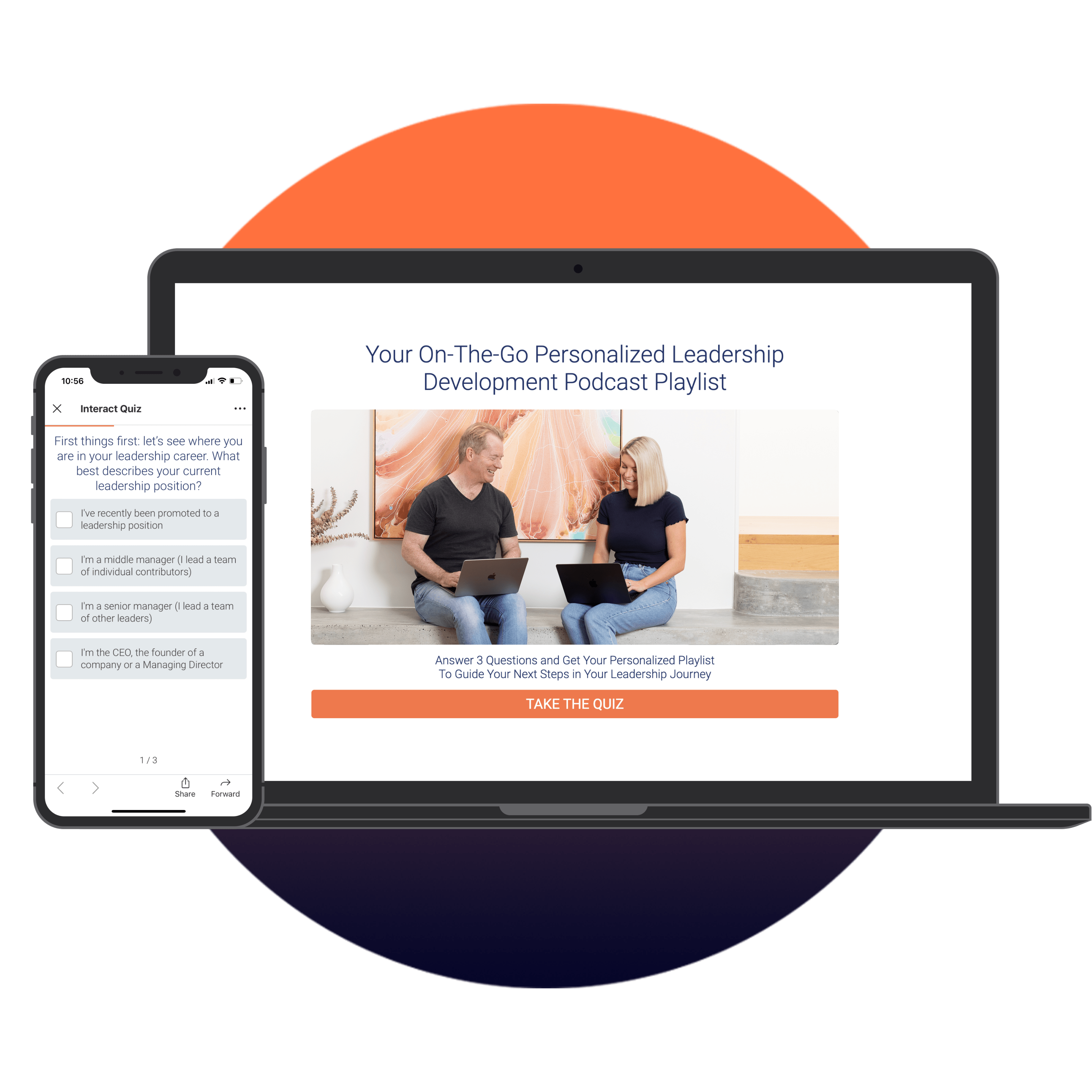
As a leader, it’s essential to constantly develop and improve your leadership skills to stay ahead of the game.
That’s why I’ve created a 3-question quiz that’ll give you a free personalized podcast playlist tailored to where you are right now in your leadership career!
Take the 30-second quiz now to get your on-the-go playlist 👇
Transcript
Episode #375
Should Your People Have a Say in Big Change?WHERE DOES CONSULTATION FIT?
I’ve written quite a bit over the years about change, particularly as it applies to leading people through major disruption.
Humans aren’t particularly adaptable, which is why a whole industry of organisational change management arose in the mid-1990s.
Some of my earliest podcast episodes addressed key aspects of organisational change:
- Ep.46: The People Who Built the House Can’t Renovate It;
- Ep.56: Dealing With Change Resistance;
- Ep.66: No Noise = No Change; and
- Ep.119: Change Fatigue.
In this episode, I take a slightly different angle, thanks to a question from our Leadership Beyond the Theory alumnus, Callen Peacock. Callen asked, “How much input should you take from the affected parties before implementing large organisational changes?“
This gave me flashbacks to my corporate days of major change and formal consultation processes. And there are some pretty big questions to ask here:
- How do you get buy-in from your people without slowing the process down?
- What’s the best way to get the right information from your team?
- How can you improve your chances of maximising the ultimate value you get from making large organisational change?
In this newsletter, I answer these questions and help you to work out what you need to do to get the most out of any change consultation process. I start by talking about the pros, cons, and misconceptions of consultation; I offer some real-life examples of consultation processes that I’ve been part of; and I reveal my top five tips for getting the most out of consultation.
THREE COMMON MISCONCEPTIONS ABOUT CONSULTATION
Whenever you need to make major change in a company, it’s important that you get as much information as you possibly can. You want to get the substantive decisions right, so it makes perfect sense that you’d seek input from the people who are closest to the action.
This is often done through some sort of consultation process, where you ask people to provide input into your proposed changes. But it’s not that easy to work out who to ask, and what to ask them.
I want to run through some of the pros and cons of consultation, but first, let’s start with three big misconceptions about consultation processes:
You have to bring people along for the journey.
Well, no… you don’t!
People join the journey at different stages; They experience varying degrees of impact through the change process; and they have different levels of expertise and capability.
I’ve seen some pretty well-run change processes that have had brief, targeted consultation phases where the majority of people were engaged quite a bit later in the process. If you make good, rational decisions, you are generally going to be okay.
You won’t face significant blow back from not waiting for everyone to jump on board. People typically join up for the journey at the right point.
Everyone has to be given a chance to contribute.
Well, no… they don’t!
With any decision-making process, you need to consult the right people. Who are the right people? Well, they’re the ones who have the expertise and knowledge to contribute directly, not peripheral players who want to express an opinion.
Only ask those who might genuinely make a difference to the outcome.
You have to action any feedback by incorporating it into your plans.
Well, no… you don’t!
You can’t change every little thing, even when the feedback might be marginally useful. You’re looking for those things that are material: any major risks that could eventuate; any major improvements that could be made; or any major factors that you may have overlooked.
You’re not looking to introduce every little tweak that addresses someone’s pet peeve.
THREE BIG “PROS” OF CONSULTATION
Let’s talk about the three big pros of consultation.
You usually get some really good ideas.
Consultation very often surfaces some smart suggestions. The people who are closest to the action often anticipate issues with a proposed change that you haven’t really considered, and this can serve two purposes:
- a) It can stop you from stepping on a landmine; and
- b) It can help you to optimise the changes while the cost is still relatively low.
If you’re open to this, consultation can be a font of value.
Consultation generally heightens engagement.
When you ask people what they think, they feel as though they’re more part of that change. It can also serve to lift their commitment to making the change work. And, even though it’s not always the case, this can be really powerful if you know how to harness it.
The consultation process helps you to identify talent.
Often, people emerge during the process that show themselves to be leaders of the future. They distinguish themselves by committing to making the process better, so that the company benefits in the end.
They don’t just succumb to the powerful forces of self-interest; the suggestions they make give you some high value options to consider. You find out what someone is made of in times of high pressure, not when you’re in steady state.
THREE BIG “CONS” OF CONSULTATION
All right, so what are the three biggest cons of consultation?
People expect their feedback to be incorporated in the final solution.
When people make suggestions, they have an expectation that their feedback is going to be considered, and this expectation is entirely reasonable. But, too often, it becomes an expectation that the feedback is going to be adopted, which is not a reasonable expectation.
In the absence of strong controls in the consultation process, this can be a big demotivating force that can eventually increase change resistance, not decrease it.
Consultation slows the change process down.
Even though it’s a necessary step in any large change process, consultation is going to slow it down. It always does.
In many larger companies, particularly those that employ people under collective employment agreements, there’s often a prescribed consultation process that the company is bound to follow. This process is normally bureaucratic, slow and incredibly unwieldy.
Time periods are often stipulated for each step, and agreed between management and the employee’s representatives.
Even if the consultation process itself yields useful results, there’s definitely a negative value offset in the time taken to conduct the process.
Consultation can be demotivating, if it’s handled poorly.
I’ve seen many poorly conducted consultation processes and, in all honesty, you’d be better off not having any consultation, than having a sham consultation process that’s poorly managed.
Just think how demotivating it is when you’re asked a question, and then the person who asked it doesn’t bother to listen to your answer.
This is extremely common in change consultation. It makes people cynical, and disinclined to do anything to help with the change moving forward.
FOUR PRACTICAL EXAMPLES
I want to give you a brief window into four of the big consultation processes that I was involved in over my years as a corporate executive.
The Takeover of Mt Isa Mines (MIM)
When MIM became the target of a semi-hostile takeover, there was almost no consultation.
I was the company’s CIO at the time. A group of consultants undertook the restructure of the IT department as a desktop exercise.
There was no broad consultation, and even though they did bring the plans to the table for us to look at, I had to fight tooth and nail to stop them from doing dumb sh!t that could have damaged their operations going forward.
They simply didn’t understand the environment well enough to make those decisions. And, let’s face it, they weren’t predisposed to listening. They just assumed that we’d be operating out of self-interest, and discounted anything we told them accordingly.
At the end of the day, they were just lucky they had people inside MIM who were interested in getting the best outcome for the transaction.
When I rate that consultation process, I’d only give it a 2/10.
Core System Replacement at NTI
When we replaced the core systems at NTI, we ran a fairly extensive consultation process across a two-year period.
It was a really lean process, because the organisation was much smaller (only about 200 employees). We understood the major risks that could come from the implementation, and that’s where we focused our consultation efforts.
Consultation worked really well. At the end of the day, the physical implementation and training could have been a lot better, but at least people knew what was coming, and we didn’t overburden them with information until they needed to use it.
Ultimately, the people did a sensational job of adapting to the new system despite a few implementation issues.
I’m going to rate that consultation process as a 9/10.
Post-Demerger Structure at Aurizon
Aurizon underwent a major restructure prior to its 2010 IPO, as the result of the demerger of Queensland Rail.
There were major structural issues that had to be accounted for. Everyone was jockeying for position and there was a major failure in the consultation process itself. It was run by HR, and there was so much politics involved that it was really hard to work out where the value lay in the restructure.
There was a real sense that backroom deals were being done between the power brokers. People felt the changes had already been predetermined before there was any hint of a consultation process. This really showed out when the change was executed.
I was at Aurizon for a good two years after that change had been executed, and I reckon the day I left it still wasn’t bedded in.
Whether or not the consultation process would’ve been an antidote to that, I don’t know. All I can say is that the consultation process felt disingenuous, and the outcomes of the restructure were poor.
I’m going to give that consultation process a rather generous 4/10.
Operational Reform at CS Energy.
We ran a big change initiative that didn’t involve restructure, so much as changes in operating processes. The object of the exercise was to increase tool time and productivity in an area of the business that was highly unproductive.
Our consultation processes included a stepped walkthrough of how time was currently being used and where the opportunities were for improvement.
We listened, we watched, and we worked to find better ways of doing things. But the change was countercultural. In a heavily unionised workforce, they saw it as management forcing them to do more without paying for the extra productivity.
Let’s leave aside the fact that, over the years, productivity had declined to such low levels that the speed of this particular operating site would be best described as glacial.
We made progress early on, but that was mainly due to the fact that the evidence was so compelling. There was no way you could say that the job was being done well.
This leads me to conclude that the consultation process at the start was really effective, but we couldn’t keep people on board. It wasn’t sustainable. Of course, after I left the company, productivity declined once again.
The consultation process that we held was in-depth, practical, and people-centered. But if you can’t sustain that beyond a single executive, then the change process was ultimately a failure.
I’m going to give that consultation process a solid 6/10.
FIVE RULES FOR GETTING CONSULTATION RIGHT
Whilst there are no hard-and-fast rules, these five guiding principles will help you to get the most from any consultation process you choose to undertake:
Don’t deviate from the prescribed consultation process.
You must follow the process. I used to hear all the time, “Marty, we’ll never be able to do this because when we consult the unions, they won’t agree.“
Well, they don’t have to agree… you just have to consult them.
The only thing that restricts management from making the changes they believe are in the best interests of the business is if they don’t follow the process for consultation. It’s the only stipulation in most processes.
Consultation has to be held according to a certain set of agreed rules. There’s no obligation for management to adopt the feedback that’s given, so deviating from the agreed consultation process would just be dumb.
The trick is to follow the process, without giving people a feeling that the outcomes are a fait accompli, and that the consultation process is a sham.
Only consult on the areas of change that you’re open to influence on.
There are some things you have absolutely no intention of changing, and if that’s the case, don’t ask people to tell you what they think.
Be clear about the things that are set in stone, and the things that are still up for debate.
In the example I just gave of the restructure at Aurizon, the whole purpose of the change was to move from a business unit structure to a functional structure.
Because this was the fundamental reason for the change, there was no point in asking people if we should restructure from business units to functional lines. It was going to happen.
But there were plenty of other aspects in the detail that were open for comments, ideas, and suggestions.
Respond to everything.
Whenever a comment is received, assuming it’s not anonymous, you should have a dialogue with that individual – preferably through their direct manager.
Tell them how you’ve interpreted their feedback and make sure you understand it fully; explain the process for having that suggestion considered.
When a decision has been made, tell them whether or not their feedback has been taken on board. If it hasn’t, tell them why not.
Communication is the key here to making the consultation process effective.
Remember that the people that built the house can’t renovate it.
There are two key principles to consider here:
- a) People generally over-index the risk of adopting a change, and under-index the risk of staying where they are; and
- b) There’s always going to be a tendency for long-standing employees, particularly those who are facing a potential loss of power and influence, to tell you why you can’t do something.
It’s vital that you think of these two factors when analysing any information that comes to you through the consultation process. This requires real judgment and quite a bit of communication.
If someone tells you that something’s high risk or maybe even impossible, you need to drill down into why.
It could just be a smokescreen that’s designed to protect the status quo… but it could also be a genuine issue that only someone with years of corporate knowledge could identify.
Surface the big issues.
You want to go hard at surfacing the big issues. One of the best techniques for doing this is to identify them in advance and focus the responses specifically on those.
There may only be a few big issues that you’re trying to nut out. Make sure your consultation specifically poses the questions that are important to that overall outcome.
If you focus on these, people are way less likely to get distracted with the ‘rats and mice’ issues, and they’ll be much more likely to think about the substance of the proposed change.
DO WHATEVER IT TAKES TO OPTIMISE THE OUTCOMES – NO MORE!
If you’re in a smaller business, you get a lot more choice; it’s less restrictive and there are fewer consultation rules to follow. Just make sure that any consultation process is lean and fit-for-purpose.
Consultation is a really important part of any change process, and a lack of genuine consultation can come back to bite you in any number of ways. It’s absolutely vital to drill down into the nitty-gritty of major change.
Top-down planning can only achieve so much. That old cliche, the devil is in the detail, was created for a reason.
You ultimately want to get the best information possible, and you want your people to be engaged; you want them to feel as though they have a voice, but not perhaps to the extent that it slows the process down and creates more division between the architects of the change (management) and the people who have to implement it.
Be aware of the cultural bias in many companies for overindulging their people in an attempt to keep them happy. Your goal as a leader is to optimise the outcomes of the change process. Anything that increases your chances of doing that deserves your full and undivided attention.
RESOURCES AND RELATED TOPICS:
No Bullsh!t Leadership:
Ep.46: The People Who Built the House Can’t Renovate It
Ep.56: Dealing With Change Resistance
Wikipedia link:
LBT link:
The NO BULLSH!T LEADERSHIP BOOK – Here
Explore other podcast episodes – Here
Take our FREE 5 Day Leadership Challenge – Start Now
YOUR SUPPORT MATTERS
Here’s how you can make a difference:
Subscribe to the No Bullsh!t Leadership podcast
Leave us a review on Apple Podcasts
Repost this episode to your social media
Share your favourite episodes with your leadership network
Tag us in your next post and use the hashtag #nobsleadership