


 Episode #409
Meetings: When to speak, when to listen
Meetings can be a political minefield, and most leaders rely purely on their instinct to get by: which means they get it wrong more often than they realise.
This episode cuts through the noise on one of the most deceptively complex leadership skills: knowing when to talk and when to shut up. It sounds simple, but It isn’t: and The Economist‘s “Babble Hypothesis” proves why getting the balance wrong can derail your career.
In this episode, I lay out a practical framework for two meeting scenarios that matter most: when you’re in the chair, and when you’re a participant in a room full of people more senior than you.
I also give you my take on three types of meeting disrupters (otherwise known as d!ckheads), and some killer lines to get them off their soapbox, without blowing up the whole meeting.
By the end, you’ll have a clear, context-driven model for moving between listening and contributing, so that every time you open your mouth, it actually counts.
LISTEN ON


The Best Leaders Find Their Blind Spots Before Their Boss Does
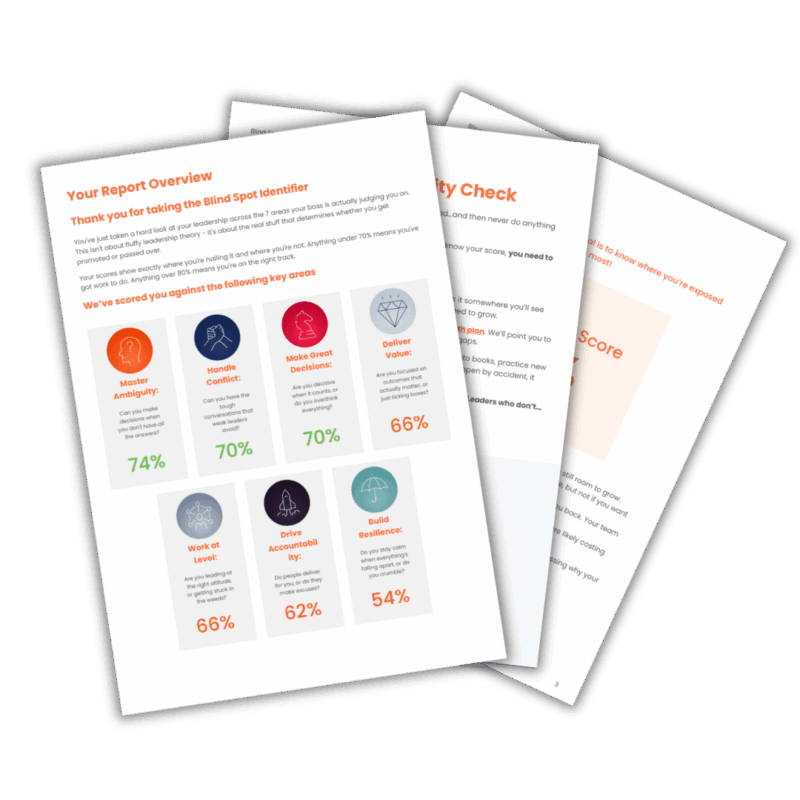
Take this free 5 minute quiz to uncover the leadership habits holding you back. Walk away with a clear report on your top leadership blind spots, and stop them before they stop you.
Start now and get your personalised Blindspot report!
Transcript
Episode #409
Meetings: When to speak, when to listenLEARNING TO CONTROL A MEETING
Meetings can be a political minefield, and most leaders rely purely on their instinct to get by: which means they get it wrong more often than they realise.
In this newsletter, I cut through the noise on one of the most deceptively complex leadership skills: knowing when to talk and when to shut up. It sounds simple, but It isn’t.
I lay out a practical framework for two meeting scenarios that matter most: when you’re chairing the meeting, and when you’re a participant in a room full of people more senior than you.
I also give you my take on three types of meeting disrupters (otherwise known as d!ckheads), and some killer lines to get them off their soapbox, without blowing up the whole meeting.
By the end, you’ll have a clear, context-driven model for moving between listening and contributing, so that every time you open your mouth, it actually counts.
THE UNWRITTEN MEETING RULES
Meetings are full of unwritten rules and conventions. We tend to learn them fairly early in our careers, because when we don’t observe them, we’re met with stern gazes, and sometimes even reprimands. For example, I remember in my early days in corporate, one boss or another would pull me aside after a meeting and whisper to me: “You can’t say that in a meeting”, or “You shouldn’t have embarrassed John in that meeting”.
And, even though I managed to look appropriately contrite, I couldn’t silence the little voice in the back of my head saying: Well, maybe John shouldn’t have said something so stupid… I didn’t embarrass John: John embarrassed himself.
There are many reasons why meetings can be tricky. In my Moments with Marty episode this week, I covered how to overcome your fear of contributing in an important meeting.
The only problem with that is, it puts you in a frame of mind where you’re only thinking about what you’re going to say, rather than listening to other people’s contributions.
As a leader, you’ll be chairing many of those meetings, directing the flow of the conversation to optimise the outcome. To run a meeting really well, you have to understand human behaviour. You also have to be strong enough to call out behaviours that aren’t productive.
There’s no doubt that, if you want to nail this, you have to be an awesome listener: not just to what’s being said, but also to how it’s being said; and, most importantly, what’s not being said.
If you aren’t listening, even when you make the most astute comment, it won’t feel as insightful to everyone else, because you won’t have as strong a connection to the flow of conversation. And if you want to maximise your contribution, this matters deeply.
The skill of listening requires you to step out of your own head; to stop focusing on yourself, and instead, focus on the other people in the room. You’ll never master this if you only do what the majority of your peers do… you may have noticed that they’re actually not listening very much at all.
They’re just trying to find a break where they can make their own point.
THE BABBLE HYPOTHESIS
There’s an old saying: You have two ears and one mouth, and you should use them in that proportion. Like most conventional wisdom, that sounds like it should be true. But, even at the peak of my communication expertise, I would have been lucky to get the time I spent talking vs listening down to a 1:1 ratio. Fortunately, my wife Kathy keeps me grounded when she occasionally says to me, “You’re a bit of a yapper!”
In the world of leadership communication, listening is no doubt considered to be more virtuous than talking. It gives people respect for their views; it maintains space for a conversation to develop; and, more than anything, listening to a diverse range of viewpoints enables you to generate way more value in problem solving and decision-making.
But if all you do is listen, you’re shooting yourself in the foot. I recently came across a brief article in The
Economist. As important as listening is, talking is a key indicator of career success. Bartleby’s Babble Hypothesis says that people who speak more tend to climb the ladder, regardless of what they say.
This makes sense, because people who talk a lot tend to be more confident… and confidence is an important leadership attribute. The article cites a paper by Neil MacLaren, who ran some experiments with a small group of students. They had to participate in a simulation, and then had to nominate who stood out as the best leaders during that process.
The people who spoke most were nominated most. Knowledge of the simulations per se seemed to be completely irrelevant. It was a case of quantity over quality.
Bartleby concluded by saying: “I firmly believe that people shouldn’t say something if they have nothing to say. But that seems to be terrible career advice.” Indeed!
We need to heed these lessons. Communication is about context (more on this shortly). No matter what, you need to inject yourself into a conversation, if you want to be relevant. Sitting back and listening to others might be comfortable, but ultimately futile, unless you join in the fray.
Developing a healthy balance of talking and listening, and knowing when to use each to best effect, is the name of the game.
HOW TO APPROACH MEETINGS
Let me start by saying, if you find yourself in a meeting where you can’t contribute, you’re in the wrong meeting. You simply shouldn’t be there. Participation trophies might be popular in kids’ sport, but they carry no currency in the corporate world.
I want to give you some guidance for how to handle the two key meeting scenarios:
- a) How to behave when you are chairing a meeting; and
- b) How to behave when you’re a participant in a senior level meeting
CHAIRING A MEETING
When you’re chairing a meeting, you should have a defined purpose, and clear objectives:
- Is it a daily huddle?
- Is it a monthly business review?
- Is it a board meeting?
- Is it an annual planning session?
- Is it a capital allocation review meeting?
There are a lot of different types of meetings, but they all have common elements. Each should have an agenda, a rhythm, and an outcome. As the meeting chair, you’re responsible for the meeting setup and structure:
- You’re the conductor of the orchestra;
- You direct the flow of the conversation;
- You’re accountable for keeping it on track;
- You need to make sure that everyone plays their part; and ultimately
- You need to ensure the meeting achieves its intended outcome;
Here are three rules for optimising communication in the meetings you chair:
Cull the guest list
Most meetings suffer from a common affliction: there are way too many people. But we’re conditioned to be inclusive, so we often invite people just in case. There’s no point in having someone in the room who hasn’t got a contribution to make… and if they should be making a contribution according to their role, but they’re not, it could be a performance issue.
An overblown invite list is a particularly easy trap to fall into when you are having online meetings. No one’s really taking up extra space, but what are they doing? If they’re not actively contributing, they may as well be playing Tetris.
Direct the flow of the conversation
Once you have the right format, and the right people in the room, it’s much easier to make the conversation productive.
As chair, it’s important that you harness the productive tension: single people out by name; ask them to make a contribution when it’s in an area that you know they have expertise; join the dots by working out whose points align, and where the differences are.
Think of it like being a facilitator in a panel discussion. Ask really good questions, and draw insights from the many competing viewpoints. You’re there to stimulate robust debate; to bring out everyone’s best ideas in an effort to get the highest quality outcome.
Ensure that outcomes and action items are clear
Don’t leave anything to interpretation. Many years ago, I realised that I had a problem with Board Meeting communication. Quite often, a director would make an off-handed comment, and before we knew it, there was a team somewhere in the company working on that initiative.
But it hadn’t actually been decided that we would action the suggestion. Eventually, I got really good at bringing clarity to those conversations. When a director made an off-handed comment I would ask, “Chair, to be clear, is this something that the board is directing us to invest resources in, or is it just a thought for us to consider?”
That response would find its way into the formal minutes of the meeting, and everyone understood the status of every comment and action item. No more running off chasing butterflies!
To do these three things well, you will have to listen… and you will have to talk… and you will have to think carefully about every statement an individual makes.
You don’t have to be the smartest person in the room, but you do have to know how to get the smartest contribution from every other person in the room.
PARTICIPATING IN SENIOR-LEVEL MEETINGS
The second scenario I want to cover is when you’re a participant in a higher-level meeting. These meetings don’t tend to happen that frequently, which is why it’s so important you know how to approach them when they do.
Let me just define which meetings I’m talking about. They’re not the ones you chair. And not the ones your boss chairs (she gets to see enough of you). They’re the meetings where people more senior than you are in attendance.
Here are my top three rules for optimising your role in senior-level meetings:
Understand the protocols
For more senior meetings, there’s always some sort of unspoken protocol. Try to work out what these protocols are by observing the cues from the chair of the meeting.
For example, board meetings require a certain level of formality. Even though, outside of the boardroom, I would call the chairman of the board by his first name, in a board meeting I would always address him as “Mr Chairman”.
There may be other protocols, though, like who’s there to speak and who is an advisor or observer. On a number of occasions, I had to attend parliamentary estimates hearings as Chief Executive of CS Energy, and in those meetings, trust me, I only spoke when I was directly asked a question.
Prepare like it matters
Every time you’re in a meeting like this, it’s effectively an interview for your next promotion, so treat it with that level of importance.
Work out who’s going to be in the meeting, and if you don’t know them, just try to learn a little about them. Look for common links in work history and industry background. Quite often, you’ll have an opportunity for a brief exchange before or after the meeting.
Then, get stuck into the content. If there’s pre-reading, study it properly. Form a view on where you sit in relation to the meeting content because, when you’re actually in the meeting, this is going to be invaluable. It will shape your responses, and give you oodles of confidence.
Don’t be afraid to respectfully disagree
You don’t want to come across as being adversarial, just for the sake of it but, having said that, you shouldn’t be afraid to bring your perspective to the meeting.
If you make sharp, insightful contributions, you’ll be noticed, even if they go against the general consensus and the flow of conversation… in fact, especially if they go against the flow of conversation.
But here’s a key tip… if possible, start by agreeing. Try to find a jumping-off point that you agree wholeheartedly with, which helps to give context to your point, and allows you to build on with your unique perspective.
To stand out, you have to show that you can listen, interpret, and respond to what’s going on in the room. For example, I would often say something like this: “I think Jackie’s assessment of the situation is spot on, but it relies on us being able to move quickly… the current schedule isn’t aggressive enough to capitalise on our head start, and if we don’t rethink it, we run the risk of losing our advantage”.
See that structure? I leveraged another point from a colleague; I didn’t repeat what she said; and instead added value by bringing my own dimension to it.
These three simple steps will enable you to intuitively decide, in the moment, when you should speak, and when you should keep your mouth shut! You might have two ears, one mouth; but the proportion in which you use them will be very different, depending on the context.
THREE ANNOYING PARTICIPANT TYPES
I want to finish with some tips for managing people who tend to derail meetings (or, in other words, how to manage the d!ckheads). I’ve got three common types to help you with:
Often wrong, never in doubt
Quite often, you’ll have someone in a meeting who is so confident that everyone assumes what they say is true. But, often, it’s just bluff.
When someone says something so confidently that no one is prepared to challenge it, just try asking calmly, “What’s your evidence for that?”. Slows them down, every time!
The conversation monopoliser
Often, you’ll have a corporate bully who likes to dominate the conversation. They’re not as smooth as Mr Often-Wrong-Never-In-Doubt. Generally they tend to be more aggressive, dismissive, and arrogant, and they won’t think twice about talking over the top of you.
It takes real strength to push back in the moment, rather than just shrinking back in your seat and seething. One of my favourite lines? “Oh, I’m sorry, did the middle of my sentence interrupt the start of yours?” It should get a laugh and change the tone, if nothing else.
The sycophantic echo
When I think of the sycophants I’ve worked with, it still makes me throw up in my mouth a little bit. One former colleague, in particular comes to mind. In executive meetings, he would hang on the CEO’s every word. He would nod profusely when the CEO spoke… and he would agree with every point the boss made.
If someone else tried to make a point, he would occasionally chime in to refute it, not with something original, but by restating the CEO’s view. What an ass-kisser! But the CEO was a little insecure, and absolutely lapped it up.
So, occasionally, I would step into the space and say something like, “Thanks very much for reinforcing the boss’s point Chris… would anyone mind if I introduced a new point into the conversation?”
LISTEN, ANALYSE, AND TALK
The challenge of working out when to listen and when to talk, is highly dependent on context. The key learning I want you to take away from this newsletter is that, to communicate effectively, you have to be able to move seamlessly between contexts.
You need to find a balance of skills: listening, analysing, and talking. Like the three legs of a stool, if any one of those is underdeveloped, the whole structure will collapse as soon as you try to use it.
The quality of your communication is a key determinant in your leadership brand. So, work on it until you get it to the point where you can perform at your peak in any context. It’s one of the most immediate ways to stand out from the crowd, and your confidence will skyrocket!
YOUR SUPPORT MATTERS
Here’s how you can make a difference:
Subscribe to the No Bullsh!t Leadership podcast
Leave us a review on Apple Podcasts
Repost this episode to your social media
Share your favourite episodes with your leadership network
Tag us in your next post and use the hashtag #nobsleadership
- Join our Free Leadership Community on Skool