


 Episode #380
Don’t Leave Your Leadership Identity to Chance in 2026
You already have a leadership brand…the question is, does it serve you?
Every leader shows up with a reputation. It might be clear and consistent…or vague, confusing, and accidental. Either way, your people have formed an opinion about who you are, what you value, and how you lead.
This bumper episode covers the three practical building blocks of a strong leadership identity: clarity on your personal style and philosophy, a leadership brand built from the inside out, and a user manual that removes guesswork so people know how to thrive under you.
We’ll look at why congruence matters, that tight alignment between what you say, what you tolerate, and how you behave when the pressure is on. Because that’s when your true identity is revealed.
Foundational tools can be taught, but identity must be designed. When you deliberately shape how you show up, you accelerate trust, influence, and results.
How intentional are you about the identity your team experiences every day?
Is it deliberate…or just a by-product of habit, pressure, and circumstance?
Lock in for this one so you can shape your identity on purpose!
LISTEN ON


DOWNLOAD YOUR FREE COPY:
YOUR LEADERSHIP IDENTITY BUNDLE
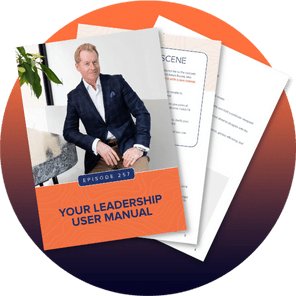
Get yours delivered straight to your inbox by filling out the form below 👇
Transcript
Episode #380
Don’t Leave Your Leadership Identity to Chance in 2026Your Leadership User Manual: Clarifying expectations for success
THE BENEFITS OF DEVELOPING A LEADERSHIP USER MANUAL
Let me begin by saying we’re breaking new ground together here today. I never implemented the concept of a leadership user manual in the days when I was leading large groups of people in corporate., so my assessment of the risks and benefits is going to be an extrapolation of my experience. This is slightly different from my usual content, which I base on my direct experience in the leadership trenches, having tested to find out what works and what doesn’t. But I’m sure you’ll bear with me as we explore this together.
Here are five benefits that I think are immediately obvious in developing a leadership user manual for your people.
- It can be an excellent tool for establishing principles.
Once people understand the principles for how something works (or, at least how something’s supposed to work), it gives it meaning. It makes it easier to understand the why. Ray Dalio wrote an excellent book a number of years ago, which was called Principles, and it does exactly that. It’s not an easy read, but it’s a must-read.
Your principles provide a blueprint for successfully accomplishing things in the right way. Most companies have KPIs to define the what, but principles allow you to speak the language of the why, and the how. This is a critical step in instilling an ethical frame for the way your people operate.
- It’s a referenceable record
You can put this at the center of any conversation. Almost no one understands exactly what you’re trying to communicate, and it certainly takes a lot more than one meeting to convey your expectations for pretty much everything.
Many conversations (sometimes dozens), are needed using different language and emphasizing different points before the penny drops. A leadership user manual would give you a referenceable point of consistency to keep coming back to.
For example, “Remember last week I said X, well, that was based on this principle. The situation I’m talking about now is similar to that. The same principle applies.”
- Consistency
It enables you to take seemingly unrelated events, decisions or directions and tie them back to a consistent set of operating behaviors. It takes the guesswork out of what you might be looking for at any given point, and why you might be looking for it. However, the downside of consistency is predictability (which we’ll get to shortly).
- It can extend the reach of your code of conduct
Assuming your company has a stated set of values, or a code of conduct, it can help to clarify expectations even further. Your leadership user guide shouldn’t contradict the code of conduct, of course, but it will enable you to put greater granularity around some of the expectations.
It also allows for the individualization of the guidelines in the code of conduct for different leaders, which demonstrates that there are many different ways to skin a cat. It’s an extra mechanism for describing the desired behaviors that you expect your people to live by.
- It keeps you honest.
Think about this. Once a leader puts her formal user manual in place, she’d really think twice about departing from these clearly stated principles. It takes away a lot of the wriggle room.
You’d have to be a bit of a sociopath to produce a formal leadership user manual and then completely ignore it.
THE RISKS
There seem to be a few pretty compelling reasons for putting one of these puppies together. But like anything, there are risks. I can think of four pretty obvious risks straight away.
- It puts the emphasis on other people adapting to your style.
And as useful as it is to set clear expectations for your people, it can naturally set the stage for a one-way flow of expectations.
In the interview I did with Scott Miller just a few weeks ago, I asked him what the biggest trend he was seeing in leadership. Scott’s view was that post-pandemic, the biggest trend was the requirement for individualization.
Producing a leadership user manual could well make a leader think their job is done, and that their people will adapt to their style. This is unlikely to be effective in the longer term. The role of leadership isn’t simply to be understood, but to understand your people on an individual basis. That’s how you’ll ultimately get through to them.
- Your leadership user manual will be necessary, but not sufficient.
It may dampen your sense of urgency around verbal face-to-face communication. But as we know, there’s no substitute for eyeball to eyeball interactions.
Let’s say all your people actually take the time to read and absorb your leadership user manual (which, in itself, of course, is a bit of a stretch).
Those who do will understand some of it, but not all of it.
They’ll interpret some of it accurately, and much of it inaccurately.
They’ll believe some things you say and feel as though they have good cause to not believe other things you say.
They’ll agree with some of the principles and probably disagree with others.
Your leadership user manual sets the foundation for you to have the many conversations you need to have to influence your people. But remember, it’s the means to an end, not the end in itself.
- Your leadership user manual might make your people feel that you’re overly predictable.
Although predictability is generally desirable, there’s a downside.
For example, if people feel as though they can predict what you’re thinking, they’ll start to make assumptions. I’ve seen people stop challenging the status quo because they prefer to not do the heavy lifting required to challenge it.
“Well, we know Marty’s going to want us to do X.”
Or even worse, “Marty says he wants X.”
I’ve been there, guys! On top of that, people become desensitized to messages over time. At the end of my five year tenure at CS Energy, I was sick of repeating the same key messages over and over and over.
Let’s face it, if people were actually doing what they knew they should, I wouldn’t have had to reiterate the point so often. But even though everyone pretty much knew that they hadn’t done what they were supposed to do, I could still see them mentally rolling their eyes. I could see it on their faces:
“Yeah, we know, Marty. You’ve been telling us for five years.”
“Okay. If you know, have you ever thought it might be worth actually doing something about it?
- There’s often a gap between how we perceive ourselves and how others perceive us.
This can be tricky and it’s quite a high risk. If your people see you as espousing certain values or operating principles, but then behaving differently, it can be really damaging.
You can easily be labeled as a hypocrite even when you are consistent… so imagine when you’re not! Opening up the door to inconsistency is a risk. It’s a risk worth taking, but a risk, nonetheless.
MY EXAMPLE…
All right, if you were working for me and I was going to describe how I work, and how to meet my expectations, here’s what I would tell you.
Per Adam Bryant and Shannon Hocking, I’d have the following eight categories in my leadership user manual (which you can get here):
- My personal style
- My leadership philosophy
- How to get the best out of me
- Things I find difficult to tolerate
- How to communicate with me
- How to be wildly successful
- What people tend to misunderstand about me, and
- You won’t enjoy working for me if…
Let’s start with number one:
- My personal style
I’m direct (you’ll never be in doubt what I’m thinking).
I’m open (there are no sacred cows and there’s no conventional wisdom that I’m not prepared to question).
I cut to the chase (I don’t dance around issues. I speak my mind frankly and fearlessly to get to the crux of the matter).
I’m inquisitive (I want to know how things work, and I want to know why you hold a particular viewpoint… you need to be able to communicate that to me).
I’m courageous (I’ve never been afraid of losing my job and, although I don’t set out to offend anyone, I’m not hamstrung by the fear of not being liked. I’m quite happy to disagree with the most powerful person in the room if I don’t agree with them).
I challenge (I’ll always push the boundaries to try to find higher performance, greater efficiency, and better results).
I have a sense of humor (I crack jokes frequently—it helps me to regulate my other stylistic elements. If it wasn’t for my ability to find humor in any situation, my style would probably make me feel way too serious and intense).
Finally, I’m awesome at the detail… (when I need to be! But I much prefer to stay at a higher level. I will always remain in the contextual space by default, taking a view from 10,000 feet).
That’s my style.
- My philosophy
I could have gone all day on this one, but I tried to boil it down to the essential elements.
Respect before popularity (do the right thing when it needs to be done because it’s right).
The standard you walk past is the standard you set (it’s a leader’s obligation to set and maintain high standards for both performance and behavior).
People have to be held individually accountable for their choices (if there are no consequences, there’s no incentive to perform—people just don’t give their best unless they feel that weight). Optimal performance only comes when people are stretched (…beyond their comfort zones, their natural limits–which is also the place where they’re happiest).
Leaders have to differentiate between individuals based on merit (never sink to the lowest common denominator… it’s not your job to make everyone feel good about themselves).
If you choose to take on a leadership role, then doing the hard work of leadership is not negotiable (you have to put your people’s best interests ahead of your own fear and discomfort).
You don’t get a free kick on leadership work just because you are a brilliant strategist or an incredible rainmaker (I expect you to put as much effort into developing talent and building capability as you do into any other part of your accountabilities).
You need to create a culture that focuses on value delivery (no blame, no excuses—respectful but challenging, with an uncompromising focus on excellence over perfection).
And, finally, for the avoidance of doubt, I believe that competitive markets are the sole pathway to higher living standards and prosperity (competition makes us all better—without it, we become fat, dumb, and happy).
Just those first two, my style and philosophy, will give you a pretty good idea of what you’re in for when you work for me. But let me finish off with a quick whip through the other six:
- How to get the best out of me
Engage! (make me part of your journey, share your challenges and problems… I see it as a privilege, not a burden to be given the opportunity to help you perform. If you’re operating with good intent and diligence, I’ll overlook a lot of other issues).
Use me for my strategic thinking ability (I know that one of my superpowers is my capacity for abstract reasoning—that’s recognizing patterns and applying them to new problems and scenarios… if you bring the detail, you’ll be able to get the benefit of my high order sense-making skills and judgment).
- Things I find difficult to tolerate
This one’s simple:
Dishonesty of any kind
Entitlement mentality
Laziness
Avoidance
Excuses
Sugarcoating a situation to play down its true level of criticality
Hiding bad news or covering up problems
My mantra is: bad news by rocket, good news by rickshaw.
- How to communicate with me.
I’m direct, open, and transparent in my communication style (I value that really highly in myself and others—the more straightforward you are, the easier our flow of communication will be).
Don’t write lengthy documents (your written communication should be clear, simple, and direct… if you can’t explain something complex in simple terms, it tells me that you don’t understand it well enough).
Talk to me at the high level in terms of outcomes (you can fill in the gaps with details as we move through the discussion… don’t try to beat me into submission by bombarding me with details in the hope of convincing me about something—it just won’t work).
- How to be wildly successful
Obviously, focus on value (understand what the biggest value levers are and focus solely on those).
Fight with every fibre of your being to eliminate non-valuating work (always think and talk about results, not activity and processes).
Do the hard work of leadership (get comfortable with difficult conversations… challenge and allow yourself to be challenged… do the basics well—performance management, capability building, and accelerating talent development).
Oh yeah, and don’t believe your own bullsh!t.
- What people tend to misunderstand about me
People sometimes think I don’t care about a crisis situation (I’m very relaxed, even when I’m under extreme pressure, and I often use humor as a stress management tool for both me and my team).
People sometimes think I only care about the results, not the people (just because I focus on results so strongly…. but nothing could be further from the truth—it’s only people that give business meaning. Those people aren’t just the employees—who are just one critical stakeholder group of many—we also have to consider customers, shareholders, suppliers, the communities in which we operate… the list goes on).
I genuinely believe that superior performance is the only way to truly satisfy all stakeholders (including employees).
- You won’t enjoy working for me if… (this is a good one. I had fun with this).
You won’t enjoy working for me if you aren’t prepared to give your best.
You won’t enjoy working for me if you just want to cruise along and count the hours of the day (and if that’s the way you feel, you have no business being on my team).
You won’t enjoy working for me if you don’t believe in the principle of meritocracy (because you’ll feel hard done by when those who perform get the rewards that they’ve earned and you’re overlooked based on your relative underperformance).
You won’t enjoy working for me if you aren’t comfortable with constructive tension, and
You definitely won’t enjoy working for me if you aren’t prepared to take unwavering accountability for your performance and behavior.
what is my leadership style?
Given that’s my first crack at developing my leadership user manual, I think it’s a pretty good start. It needs some fine-tuning, no doubt, but it’s a pretty reasonable representation of who I am and how I operate.
I really hope you’re going to take the opportunity to develop your own leadership user manual, so that you can give your team greater clarity about how to be successful under your leadership. To make this easier for you, don’t forget to download your own leadership user manual template.
I’ve been asked many times, particularly over the last few years since Em and I started our current business, to describe my leadership style. My answer’s always been pretty simple:
“If you want to be your best… if you’re ambitious and career-driven and you want to play on a winning team, then I’ll be the best boss you’ve ever had.
“But if you just want to cruise along and do an average job, you will hate every minute that you work for me. Why? Because I’m not going to let you be mediocre.
“If that’s what you want, I totally understand and, without any hard feelings, I’d be happy to support you by helping you find another role that’s more suited to your aspirations.”
In the future, when I’m asked this same question, I won’t need to explain it all. I’ll just hand them a copy of my leadership user manual.
Reinventing Your Leadership Brand
YOUR LEADERSHIP BRAND IS IMPORTANT
We hear a lot these days about personal branding and there’s an expert for every occasion promising to guide us through the leadership branding maze.
We’re told how important it’s to have a strong leadership brand if we want to progress in our careers. Well, look, that’s probably true… but there’s a dangerous misconception that you can construct an external image of desirable behaviours and values without actually possessing them.
That approach is doomed to failure.
The people in your professional sphere need to know who you are, and they need to know what you stand for. So to that extent, building a strong brand around your positive attributes, and being clear on what distinguishes you from other leaders can be highly valuable.
In this newsletter I define what leadership brand is; I give you a very specific example of how you can change any given element of your leadership brand; and I’ll leave you with two practical tools to help you with any changes that you might choose to make.
WHAT IS LEADERSHIP BRAND?
It’s become pretty popular to talk about personal brand. LinkedIn is full of experts offering to help you build your brand, and this has now bled across into the broader culture: you know it’s a thing when Matt Stone and Trey Parker, the South Park guys, decide to dedicate an episode to it!
Your personal brand is just the perception that others have of you, based on your personality, your behaviours, and your communication style – it’s how you show up in the world.
The key elements that make up your personal brand are:
- Your values;
- Your defining strengths and weaknesses;
- Your communication tone and style;
- Your external image (the way you present yourself, the way you dress, your personal grooming etc);
- The reputation that you’ve built over time, based on your actions; and
- Anything else you are known for.
Just to be clear, what you don’t want to be known for is for the time you got blind drunk at Friday drinks and declared your undying love for one of the junior analysts.
Your leadership brand is just an extension of your personal brand, and it incorporates things like:
- Your values, competence, and credibility;
- How you interact with and influence others;
- The consistency and quality of the results your teams deliver; and
- How people feel when they work under your leadership.
To bring this concept to life, I just want to take a quick look at the similarities between brand and team culture.
Culture as we know, is just the way we do things around here. Every team has a culture, whether it’s formed deliberately or accidentally. A culture that isn’t created consciously will just follow the path of least resistance. It’ll grow like weeds. You’ll just get what you get, unless you choose to do something different – something that explicitly shapes the culture.
Changing a culture takes committed effort from the leader, and this is why team culture is determined to such a great extent by who happens to be in charge at any given point in time.
Your leadership brand works in a similar way to culture – the people who interact with you each day see how you talk and act and behave, and from this, they infer how you think, and what’s important to you.
Like it or not, you already have a leadership brand. Do you know what that brand is? If you could change one thing about your leadership brand, what would it be? If you were able to change it, would it increase the likelihood of you achieving your career ambitions?
Being conscious about building your leadership brand is a no-brainer. The problem though is that some brand experts are going to encourage you to contrive your image to create a more positive perception, regardless of who you are and what you stand for at your core.
Building a shiny facade to cover your true identity is a bad idea, and in a few paragraphs’ time, you’re going to understand why.
START WITH YOUR LEADERSHIP USER MANUAL
There’s nothing wrong with working to improve your leadership brand. In fact, if you want to be successful in corporate life, it’s almost essential that you pay attention to your brand.
But it has to be done in a particular way. Your brand has to be built from the inside out. It can’t just be a facade. You can’t just throw some window dressing over the mess that lies beneath, and expect it to change your underlying success equation.
That’s just putting lipstick on a pig and eventually lipstick wears off. Sooner or later, you’re going to be found out, because you can’t keep up the charade forever.
The closer your brand aligns with who you truly are, the more powerful it’s going to be.
It’ll be more consistent and compelling because you never have to think about how to talk and act. You’re just you – for better or for worse.
Those who come from the fake it until you make it school of thought will give you all sorts of advice about how you need to appear. But then in the very next breath, they’ll tell you how important it is to be authentic… and fallible… and courageous…
That advice is, of course, ridiculous.
I’ve mentioned on several occasions the concept of the leadership user manual. In Ep.257, I home in on the elements of leadership that your people are going to find useful to understand:
- Your personal style;
- Your leadership philosophy;
- How your people can get the best out of you;
- The things you won’t tolerate;
- How to best communicate with you; and – my favourite part,
- “You won’t enjoy working for me if…”
Your leadership user manual is a good place to start your thinking process. Then, of course, you have to realise that your job as a leader is to set the tone, the pace, and the standard for your people.
As they get to know you better, your brand is also going to include :
- How clearly you set objectives;
- How you respond to pressure;
- Your level of professional judgment and credibility;
- How well you engage the team;
- How you manage peer relationships;
- Your level of confidence; and
- How you handle poor performance and unacceptable behaviour.
Understanding these things, and being mindful of what you’re putting out into the world is super important. But this assumes that the brand you’re generally known for is consistent with what you think it is.
DON’T TRY TO BE SOMETHING YOU’RE NOT
The cardinal sin of personal brand is trying to be something you’re not.
I just want to give you a really practical example of how you might go about changing just one of your leadership brand characteristics.
Let’s say you wanted to be a more courageous leader, and this wasn’t something that you were known for.
Where would you start?
What would you have to change?
What habits and disciplines would you need to adopt?
You can’t just change your professional resume or your LinkedIn profile to say, “I’m a courageous leader” because, if you’re not, people are going to work it out pretty quickly.
Likewise, you can’t just pull out pithy quotes to imply that you’re a courageous leader when you are not. You know the quotes – “Courage isn’t the absence of fear, it’s being afraid and taking action anyway!” which, by the way, is a pretty cool quote.
If you want to be more courageous, you should probably start by working out what it would look like to have real leadership courage.
What do courageous leaders do? Well, let’s make a quick list:
- They aren’t afraid to speak out when they believe something’s important, especially when it doesn’t align with the popular view;
- They choose to do the right thing when it needs to be done, even if it doesn’t align with their personal interests, or it puts them at risk;
- They have hard conversations because they value the duty of care to their people more than they value personal discomfort;
- They uphold a high standard because they believe it’s fundamental to a healthy culture and high performance;
- They put organization first, then team, then themselves; and
- They don’t walk away from their values when it gets hard… or when it gets expensive.
At any point in your life, the level of courage you have depends on the circumstances you’ve endured and the choices you’ve made.
This is why the path to being more courageous requires that you choose to endure different circumstances and make different choices.
HOW WOULD YOU CHANGE (IF YOU CHOSE TO)?
Once you have a pretty solid idea of what being more courageous might look like, it’s time to put a plan in place – nothing elaborate, just a commitment to act differently.
My big tip? Don’t be overly ambitious!
You’re not going to feel more courageous all of a sudden… but don’t worry, you just need to take baby steps.
I would start by putting three things in your calendar every day and to make the commitment that you can’t stop work for that day until you’ve done at least one of those three. For example, your three things might be:
- I will speak up in a meeting where I have an alternative view from the majority;
- I will have a 1:1 feedback conversation to help one of my people improve;
- I will make a decision that I have subconsciously been putting off ,because I’m afraid I’ll get it wrong.
This is going to take a little conscious thought and planning. You have to look for opportunities to make it happen, but it doesn’t have to be a big deal.
The 1:1 conversation could be a 30-second sidebar in a corridor to make an observation about something one of your people has done; it could be a highly positive and affirming interaction; or it might be a critique of something they need to improve.
The point is, don’t make too big a deal out of it. The object of the exercise is just to get used to acting. Just get into the habit of doing it before you think too deeply about it.
If you follow your plan, and choose one of those three actions every day, you’ll feel completely different about your level of courage in no time at all.
Obviously, this is just one example of how you might approach it, so I think it’s useful to deconstruct the critical parts of this process:
- The first thing is you have to know what good looks like (in our example, what is it that courageous leaders do?);
- Next, you have to identify the specific actions that you’re going to take that will enable you to move from where you are to a more desirable place;
- Then you have to make a written plan that you can look at every single day;
- After that, you have to commit to taking deliberate action; and, most importantly…
- Congratulate yourself for doing the hard thing, when you could easily have avoided it.
… and in 90 days you will have changed your leadership brand from the inside out!.
TWO VITAL TOOLS
Now that we’ve covered a practical example of how to change something that’s going to improve your leadership brand, I want to give you two tools that are going to make the process more predictable. This will increase your likelihood of success exponentially!
- My rollout methodology.
If you’re trying to make a change, no matter what it is, you’ll find that you are much more likely to be successful if you declare your intentions publicly. This one move, in and of itself, is going to set you up for a potential brand boost.
If you just decide to make a change and quietly try it out to see what happens, without telling anyone what you’re doing, there are two risks that are going to potentially derail you.
The first risk is that you are leaving the back door open. If no one knows what you’re trying to do, it’s really easy to slip back into your old habits – you’ll try it out, and if it doesn’t feel good, or if you don’t see it working straight away, you’ll just quietly go back to your old ways and no one will be any the wiser.
Clearly, that’s the safest way to make change, because it involves the least personal risk. But it’s certainly not the way to set yourself up for a lasting positive change to your leadership brand.
The second risk, which flows on from this, is that you can’t expect people to work out what you’re doing differently unless you tell them what you’re trying to do.
As an example, I’ve seen leaders decide to raise the standard of performance in their teams, without giving their team any rationale for what they’re trying to do… it just looks like they’ve become more demanding, and less tolerant of their people’s missteps
The team generally won’t see this as a positive. Most people are going to think to themselves, “Geez, Marty’s in a bad mood today. I wonder what’s got him all bent out of shape.”
This is why you have to be open with your team about any changes you decide to make. People need to know what you’re trying to do, especially if you’re changing something about your own leadership behaviour and approach that places different expectations on them.
You’ll need to communicate your intentions – first to the team, then to each person individually – so that they understand their specific context.
Let’s stick with our courage example for now. The first thing I would do is to call my direct reports together and tell them what I’m trying to achieve (and why). I’d probably go with something like this:
“I realise that I’ve been holding the team back. I’ve been too cautious in my approach, and I haven’t been representing you as well as I should have. I need to be a little bolder in how I approach every situation, especially the broader company issues. I want to be more decisive, and I also want to do you the courtesy of setting out my expectations more clearly. I’d really like you to help me by letting me know if I’m slipping back into my old habits.“
This lays the foundation for every future conversation: you’ve announced your intention, and you’ll be able to point back to that line in the same conversation whenever you feel the need.
After the team conversation, you then hold individual meetings with each of those direct reports.
These meetings have a dual purpose:
The first is to remind people of the messages, and to let them know what you expect from them, in light of your own change in approach.
The second is that it gives you an immediate opportunity to tick off your courage goals in the first week. If you committed to doing one 1:1 meeting a day, then over the course of a full week, that should cover your direct reports and get you in the habit of meeting one of your three courage commitments every single day.
I go into this methodology in a lot more detail in our Leadership Beyond the Theory Program, but that just gives you the bones of it.
Set the tone for the people around you, enlist their help, and be clear on where they fit into the picture.
- Your habit tracker.
I’ve been using this for years to keep myself honest when it comes to the personal habits that I know make the most difference to me… and, let me tell you, when I’m not on point it becomes really obvious… really quickly.
My habit tracker gives me a visual record of my personal performance over a daily, weekly, and monthly period. It’s just a simple Excel spreadsheet that you can use to define and record and track pretty much any habit you’d like to adopt.
The magic number seems to be 90. Of all the research that looks into the formation of sustainable habits, 90 days seems to be the threshold that prevents backsliding.
If you can keep up your intended habits for 90 days, you’ll be much more likely to make them stick in the long term.
You can set up a habit tracker specifically to cover the things that you most want to build into your leadership brand. But just remember – the simplicity and focus principle really applies here. Don’t try to change too much at once. You’re looking to get the biggest bang for buck from any dedicated effort that you might choose to apply.
As a bonus resource, you can get access to our free habit tracker spreadsheet template here.
BUILD YOUR BRAND FROM THE INSIDE OUT!
If you take nothing else out of this newsletter, I’d like you to think about one core principle:
You can’t change your leadership brand with a new suit, a photo shoot, and a few AI-generated blog posts.
You have to change yourself from the inside out.
If you’re setting out to reinvent your leadership brand, you have to accept that nothing changes unless you do the work to change it…
But if you commit to making a change for 90 days, you’ll discover that even the most elusive qualities can be built into your permanent leadership repertoire.
Crafting Your Leadership Identity: Q&A with Marty and Em
WHAT IS LEADERSHIP IDENTITY, AND WHY DO YOU NEED ONE?
There are a few things that contribute to your leadership identity. We need to start with the underlying framework that every leader needs to have in their kit bag, which should be reasonably common… but then we need to build our individuality over the top of this.
We talk about your leadership fingerprint – that uniqueness that you bring to the role. We also talk about your personal leadership “user manual”, which is an awesome way to let your people know what to expect from you.
But why is it so important to have your own leadership identity?
I think probably the most important thing is that it’s hard to do it any other way. Every individual is different. Everyone has different experiences, upbringings, preferences, and personalities, and all of these feed into who you are.
Whereas you’re going to need some really strong fundamentals for how to lead people, by the same token, you’ve still got to be you. People talk a lot about authenticity, which I’ll go into shortly, but it’s really about being who you are and still being able to be a strong leader within that.
If you’re not, people are going to pick it – it will show up as a lack of authenticity, which destroys trust.
DOES YOUR LEADERSHIP IDENTITY COME FROM NATURAL TALENT?
Your leadership identity has to naturally evolve – raw talent isn’t enough.
Some people are more predisposed to leadership than others, and we know that. The difficulty is that if you just go by your natural instincts and you don’t have the framework for strong leadership, a lot of this stuff is actually counterintuitive.
Let me give you an example: I played a lot of team sports when I was growing up. In team sports, “leading from the front” means a completely different thing than it does in business. You have to be aware of the fact that the context of business is slightly different when you’re leading people.
On a football field, for example, leading from the front means you are putting in the most effort; you are doing the most work; you are showing people how to rise up in times when you’re going through adversity. And everyone follows you because you are setting the example for them for what they need to do. You model the exact performance you want from each team member.
In business, the concept is slightly different. OK, you still need to lead from the front, but you do it in a completely different way. You don’t do your people’s work for them. You’re not the captain of the team with the same job as the other players. You’re the coach on the sideline. You are helping people to lift to be their best. And the only way you can do that is by stretching them and letting them do their jobs – not by doing their jobs as an example for them.
In that context, leading from the front means something totally different. It means you’re demonstrating the right attributes, the right characteristics, the right values. You’re showing them commitment to the job; you’re showing them a standard of excellence; you’re showing them that you’re accountable for what goes on, but still in the context of your own role.
That’s just one of the subtleties that doesn’t translate well between the natural leadership of someone who’s come through as a captain of a sporting team, and someone who’s got to lead in a corporate environment with many layers of people below them.
So talent, plus a solid leadership performance framework, can combine to form your leadership identity. But they don’t just automatically integrate themselves. You need to do a lot of work to actually practice the skill of leadership. It takes repetition, like anything else. You’ve got to do your 10,000 hours of high-quality, dedicated practice if you want to be expert at anything.
The repetition helps you to consolidate the principles that you need, the foundations of leadership, and then to build into that your own personal, individual uniqueness. And that’s not easy to do. It takes a lot of thought. It takes a lot of deliberate, methodical planning about how you want to incorporate things, and ensure that they’re consistent with who you are. Because if you don’t have that level of congruence between who you are and the way you’re acting, people will see that, and it results in lack of trust.
HOW DO YOU FIND THE RIGHT FOUNDATIONAL LEADERSHIP FRAMEWORK?
We know that a lot of leadership frameworks aren’t very implementable. There’s a lot of stuff out in the world that’s aspirational and motivational and, although this can be useful, it’s not practical enough to really do anything with.
When we talk about practical leadership tools, we’re talking about the things that you can take and use every single day to get better at a particular element of leadership: whether it’s working at the right level, becoming more resilient, handling ambiguity better, or making decisions in a more rapid but methodical way. There are a lot of things that you can work on depending on what you feel as though you need to incorporate into your leadership repertoire at any given point.
When we developed our Leadership Beyond the Theory program, we were focused on the bedrock – that foundational level that says, “If you do these things using these tools, you’ll be better at leading in this way.”… regardless of where you are in your leadership career.
But we also knew that everyone’s going to be at a different stage in their leadership journey, and they’ll need to apply the tools and principles completely differently, depending on their unique personality and experiences.
For example, when applying the critical principle of working at the right level, some leaders are going to be naturally very nurturing… whereas other leaders are going to be more challenging to their people and expect them to step up and fill that vacuum that they leave. In this way, working at the right level may look very different based on how much support and nurturing that leader is prepared to give people who they’re trying to coach and mentor through the process.
As an individual, when you try and work out how you’re going to incorporate that, it’s all about, “How do I do this in a way that’s natural for me, that’s consistent with who I want to be as a leader, that supports my values set?“
But the principle of working at the right level is identical. No matter who you are, no matter what level you’re operating at, no matter what industry you’re in or where you live, the principles are the same. It’s your deep understanding of the principle that enables you to then incorporate it into your own style.
HOW DOES YOUR LEADERSHIP IDENTITY IMPACT THE TEAM DYNAMIC?
The primary purpose of leadership is to be able to drive your team to get the right results – to create superior performance, and extraordinary value for your most critical stakeholders. Remember, leadership’s all about getting results – so you have to deliver value, regardless of anything else you choose to do. But different leaders with different identities will do it a slightly different way.
More than anything else, you need to establish trust in your team. And you can’t establish trust unless you have a level of congruence. But you also need a level of competence and skill. And you need to apply some of the principles that are absolutely necessary to get outstanding results, like driving single-point accountability through your team – not having an autonomous collective that basically makes all their decisions by consensus.
Having those fundamentals and then working out how to leverage them is really important.
The object of the exercise is to build trust. You can’t do the hard work of leadership without it. And to do that, you need to have some empathy for your people. I’m not saying that you need to be sympathetic. What I’m saying is, you need to be able to see the world through your people’s eyes. You need to be able to show them that you understand them, and you can talk to them on their level and you can relate to them. Once you begin to relate to people in a connected way, they’ll start to trust you.
Of course, they won’t fully trust you until you show them how you respond when things go badly: every leader can sail in a calm sea, right? It’s when things go badly that people look to you and say, “Well, what happens now? Am I going to get hung out to dry or am I going to be supported?” Those critical moments are either the icing on the cake that consolidate trust, or they destroy everything you’ve built prior to that.
Any dissonance between what you say you’ll do, and what you actually do in practice is incredibly unnerving. It just makes people think, “I don’t know what to expect from this person.“
It’s also incredibly common knowing because leaders revert to type when the pressure is on. We all do. Our natural tendency is to go back to what we know best – what we’re most comfortable with. This is despite the fact that we might be very controlled and methodical about how we present ourselves to the world. Virtually everyone comes to work with their game face on – a mask of some sort.
What does it take to make that game face crack? What is it that makes it impossible for the leader to continue in a calm and rational way, but instead to give into the fear that comes when things go wrong?
People are always going to want to know that you’re good under pressure. This is why we talk in Leadership Beyond the Theory, specifically about the concept of grace under pressure. It’s the complete congruence between what you’re showing on the outside, and what you feel on the inside – that calm, rational, logical, supportive approach to problems, no matter how dire they might be.
You don’t feel stressed or pressured or anxious. You feel as though you’re in control, and your people feel that way too. That’s a pretty useful characteristic to have as part of your leadership identity!
CREATING YOUR OWN LEADERSHIP IDENTITY
Start by knowing yourself. Introspection and self-awareness are key elements that you need if you want to improve. You can’t work out how to get better if you don’t know where you’re weak, and you don’t know where you’re strong.
It’s really important to know your strengths and weaknesses – not just what you’re good at, but also what is it that really lights you up? What do you enjoy doing? Your strengths are the combination of these two things, so ask yourself: “What am I good at?” and “What do I like doing?” Your weaknesses are the areas in which you should be able to perform, and may be expected to perform, but you actually can’t perform, for one reason or another.
I think there are varying degrees of weaknesses, some of which are more impactful than others. I’ve seen some leaders who have weaknesses that I would call showstoppers. When I would see these, my very strong feedback would be, “Until you resolve that weakness, I can’t promote you to the next level because the next level requires X, Y, or Z. And if you don’t have that, it’s simply not going to work”.
I’ve had many of those conversations. But more commonly, self-awareness lets you think about positive improvement : “Okay, if I were to put time and energy into improving, what area would give me the biggest bang for buck? Where would I start if I wanted to get better? What’s the thing that prevents me from being my best when I’m leading? What’s the thing that scares me or that I can see clearly isn’t getting results and serving my team the way it should?“
Start there. Start simple, start small, and build your confidence as you build your leadership identity..
Over time, you’ll experience many changes in your leadership identity – it’s constantly evolving. But how do you know what’s really changing, and how can you maintain awareness of your forward progress? “What has my leadership identity morphed into? Is it what I want it to be?“
One way to keep track is to just look at the scoreboard. “Am I getting results?“
This is the acid test for any leader – achieving superior performance and results. So, ask yourself, “Are my results where I want them to be?” If they’re not, think about what you’re doing. Think about the inputs, think about the front end of what you’re doing. Are you doing the things that should make you successful, logically? That’s a good place to start.
The other thing is that if you’re doing something that isn’t consistent with your value set or your approach or the way you want to be as a leader, it will feel that something’s off. It’ll feel like, “Well, this isn’t quite right.“
It happens all the time in business – as a leader you’ll often be asked to do something by your boss that you don’t feel is the right thing, or you don’t feel good about, or you feel as though there’s a better way. Those are the critical points where you either say, “Look, I’m not up for this. I don’t think this is the right way to treat people” or “I don’t think this is the best thing for the business“, and then you have that out with your boss.
Many leaders who are conflict averse can’t do that. And so the boss says, “I need you to go away and do this for me.” The dutiful leader says, “Sure, boss, I’ll do it” and then finds herself in a conundrum: “I know I’ve agreed to do this. I know that the boss wants me to do this, but I don’t feel as though it’s something that I should do.” This causes a gradual erosion of your confidence and self-respect, as a result of doing too many of the things you know aren’t right, or you don’t feel are consistent with who you are.
This happens to all of us to some extent. You can’t walk out of a job the first time your boss says, “I want you to do something“, and you say, “I don’t agree. You know what you can do with your job, boss!“… that’s not the way that it normally rolls out. But there’s a real strength and a real power in being able to have the conversation with your boss where you say, “Look, I just don’t agree with this for these reasons“.
But if you get pushed too far away from where your values set is, then eventually you’ll be left with only one option: to vote with your feet.
BRINGING ALL THE ELEMENTS TOGETHER
If you want to explore this concept further, we have a host of free tools, the most relevant being:
Remember, you will have a level of uniqueness to how you behave and perform as a leader. But despite that, you still have to have the foundational elements of what good leadership is. If you want to be a strong leader who gets results, there are certain things that are predictably useful, and have a huge benefit: they’re good for the team, they’re good for you as a leader, and they’re good for the organization you are leading in.
Having self-awareness to know who you are, to know what’s important to you, to know your strengths and weaknesses, is incredibly important. Oftentimes, a trusted advisor can be helpful to you in gaining that self-awareness. A trusted advisor will give you the feedback you need, not necessarily the feedback you want!
You need to bear in mind that there are nuances between the natural leadership style that you might’ve learned as a child growing up, and what’s required in a multilayer organization where you have to lead large teams of people.
And then, of course, there are the leadership staples of trust, empathy, and congruence. Do your people see you as a congruent leader, who sticks by your values and principles when times get tough and when the pressure’s on?
The most important thing is that you are deliberate and thoughtful about how to craft your leadership identity… in a way that enables you to deploy the proven tools and techniques of high-performance leadership, while still letting you be you!
YOUR SUPPORT MATTERS
Here’s how you can make a difference:
Subscribe to the No Bullsh!t Leadership podcast
Leave us a review on Apple Podcasts
Repost this episode to your social media
Share your favourite episodes with your leadership network
Tag us in your next post and use the hashtag #nobsleadership